September 15, 2014

August 29, 2014
Grub Street Saved from Gentrification!
As we reported in our previous post, a cash-strapped
Grub Street writing center has told the world that it is barely holding on in
the midst of a furious storm of gentrifying downtown development. But before it
would be forced to relocate to some strip mall outside Route 128, come hell or
high water it was going to establish the Literary Cultural District, which will
safeguard both Boston's literary heritage as the "Athens of America"
(because one good slaveholding democracy deserves another) and the city's current
and much-remarked "literary renaissance."
Well, now we don't have to worry any more – a
source of funds has been found which will allow Grub Street to remain downtown
in the Steinway Building, or at least somewhere else within our new Literary
Cultural District: Eve Bridburg's salary.

(I've blurred out information on individuals who don't concern us here)
Yes, publicly-available tax documents obtained by
this blog reveal that Grub Street's Founder and Executive Director earned a
remarkable $104,020 in 2012. That's 3 times the median per capita income
of the city, $33,000 a year.
Also impressive is the steep rise her salary has
undergone in the last few years, from 60 grand in 2010 to 95 grand in 2011 – a raise of 35 thousand dollars in a single year, followed next year by another bump of 10 grand! And at that rate, who knows what her raise for 2013 might've been?
All Ms. Bridburg has to do is return to her 2010
salary – still almost twice as much as the median Boston per capita income –
and Grub will be flush enough to remain the stout tentpole of the Literary
Cultural District.
And don't worry too much about our Executive Director: Her spouse
is an extremely well-remunerated doctor with his own lab in the Longwood
Medical District, so this great gift she is giving won’t pinch her family too
much. This is an era in which we're all being forced to tighten our belts, and
pull ourselves up by our own bootraps or be hoisted upon our petards or
whatever, so it only stands to reason that the Great Mother of our Literary
Renaissance will do her part, too.
August 26, 2014
Eve Bridburg Finds the Gentrification-Spot!

G marks the spot!
On August 19, the Massachusetts Cultural Council approved
the “Literary Cultural District” application submitted by GrubStreet writing
center and a raft of other Boston literary organizations. The approval was
punctuated by the usual round of media flatulence, including this offering by BostInno dudebro Nick DeLuca:
“It marks the second state-designated area of this kind – the first, also
in Boston, being the Fenway Cultural District – and the inaugural in the nation
being of the literary variety.” This marks the fifth article on the LCD by
DeLuca being of the illiterate variety.
But in the midst of all the triumphalism an uncharacteristic
note of caution sounded from the van of the parade.
Consider the following quote in the same article from none other than GrubStreet founder and director Eve Bridburg:
Areas like Fort Point channel have
seen their artistic communities pushed out due to rising costs,
and GrubStreet faces a similar challenge as our building is being sold and
we too are being forced to consider options outside of the city. The approval
of the creation of a literary cultural district in downtown Boston is an
important milestone for a city that is trying hard to maintain its cultural
heart. With an intentional, coherent approach to our collective work as
literary organizations, publications and endeavors, we will put Boston on the
map as a literary center and destination.
I had to rub my eyes and even walk around the block when I
read this: Eve Bridburg talking about . . . gentrification? Who said anything
about gentrification? How did this notion even enter the conversation? When in
the year-long public history of this project have its organizers,
spokespersons, and media shills expressed the least syllable of concern about
the g-word?

That Gioconda smile can only mean one thing!
While we’re pondering that question (or alternately savoring
the cheeky humor behind the assertion that the city is “trying hard to maintain
its cultural heart”), let’s spice it up with two additional ironies:
1) Bridburg and Co.
have waited until the district is a done deal to say anything about
gentrification. I’ve been watching this process unfold for a year now,
thinking hard about it and doing the homework about cultural districts and
gentrification that the LCD's supporters don’t seem to be interested in. And during
that time, there’ve been some things that have struck me – as they would any
honest observer – as deeply manipulative and dishonest, including the obvious
conflicts of interest (Ayanna Pressley’s seat on GrubStreet’s “Literary
Council” and Grub board member and donor Laura Debonis’s boasted residence
“in the literary cultural district”), the deliberate deception about the
openness of the project (no substantive attempt to rally people to the “public”
hearings), and the egregious corruptions of language from people professing to
be writers or book lovers (“literary renaissance,” “branding,” and the serial
abuse of “community”, etc.). But so far nothing
beats this for sheer cynicism.
Because Eve Bridburg herself has just admitted that concerns
about gentrification are relevant to this process. In fact they are so relevant
that the very first public words out of her mouth after the district’s final
approval address this very topic. Yet concerns about
gentrification could’ve been addressed at
any time along the way. Waiting until this moment gives the impression
that the organizers failed to bring it up because they knew that due diligence and genuine democratic participation and accountability might
cause problems or slow the process. Instead, they kept their mouths
shut and rushed the process as much as possible.
By waiting until now, Eve Bridburg couldn’t have admitted
more loudly that gentrification is a legitimate concern when it comes to the
literary cultural district – and she couldn’t have added any louder that she
doesn’t give a shit.
2) Bridburg’s statement
suggests that LCD status will somehow actually help with the problems posed by
gentrification. This is of a piece with other vague assurances such as
the repeated assertions that the LCD will “help writers” by “raising their
profiles” or whatever other “branding” bullshit is on offer. But in real terms
it’s a non sequitur (as well as a plain old lie), because cultural districts, as I’ve shown
in previous posts, were developed for the very purpose of bringing up property values. The same sleazy rhetorical move is on display at the end of an unsigned
Boston Globe editorial that appeared several
days after Bridburg's statement:

At least the Massachusetts Cultural Council, a state agency, feels constrained in its own
announcement to be more forthright about the purpose of cultural
districts:

Take note of a couple of points in particular. The MCC reports that, "the Cultural Districts Initiative grew out of an economic stimulus bill" – an ECONOMIC STIMULUS BILL, not some kind of fairy-tale, feel-good "cultural stimulus bill"! The language of the third paragraph drives the point home: to "encourage business," "expand tourism," and "enhance property values." Could it be any clearer?
Now, someone might logically point out that there are one or two points about art and culture in the description, such as "attract[ing] artists and cultural enterprises" and "foster[ing] local cultural development" – shouldn't that count for something? And of course it does: it counts for the kind of art that can "encourage business"; it counts for the kind of culture that will "expand tourism"; it counts for the type of creativity that will "enhance property values." This is a recipe for gentrification.
So to sum up, here’s what Eve Bridburg and GrubStreet and the other “Executive Partners” in the LCD coalition (Deborah Porter of the Boston Book Festival, Henriette Lazaridis Power of The Drum litmag, plus Suffolk University, Emerson College, the Boston Athenaeum, and Boston Public Library) are telling you:
Now, someone might logically point out that there are one or two points about art and culture in the description, such as "attract[ing] artists and cultural enterprises" and "foster[ing] local cultural development" – shouldn't that count for something? And of course it does: it counts for the kind of art that can "encourage business"; it counts for the kind of culture that will "expand tourism"; it counts for the type of creativity that will "enhance property values." This is a recipe for gentrification.
So to sum up, here’s what Eve Bridburg and GrubStreet and the other “Executive Partners” in the LCD coalition (Deborah Porter of the Boston Book Festival, Henriette Lazaridis Power of The Drum litmag, plus Suffolk University, Emerson College, the Boston Athenaeum, and Boston Public Library) are telling you:
Gentrification is a real issue here, but the Literary
Cultural District will somehow help with that in some unspecified way, even
though cultural districts were designed to do just the opposite, and anyway
it’s too late because we waited until the LCD was in the bag to mention any of
this inconvenient crap.
OK, got it – thanks, GrubStreet!

July 30, 2014
The "Literary Cultural District" and the Art of Rent -- Part 1

Does that mean Grub Street will be returning half of the 2-year
planning grant it received from the state in the Fall of 2013? (42,500 taxpayer
bucks for a project repeatedly billed as “revenue neutral.”) Somehow I think not,
but at this point such straightforward theft is one of the less sleazy aspects
of this case. As a writer – and a just as a rational, ethical human being – I’m
more offended by their serial abuse of an infinitely more precious currency: language.
For example, in the latest wave of uncritical, rah-rah articles about the
project, city councilor Ayanna Pressley is quoted applauding the district
because it will “incentivize foot traffic” in the area. Any writer worth her
salt will be deeply revolted by this kind of thing, as she would’ve by Eve
Bridburg’s classic from an earlier interview, “We’re thinking about branding
the work that everybody is doing.” Worst of all is that “Literary Cultural
District Coordinator” Larry Lindner is back to claiming that Boston is in the
midst of “a literary renaissance.” During the city council process a chastened,
or at least more cautious, Grub Street had downgraded their momentous cultural
rebirth to a still hugely overstated “resurgence.” It’s a sure sign they
feel the wind in their sails that they’ve now returned to the brazen ad-speak –
or what, in simpler times, was known as lying
– of “renaissance.”
The single note of caution sounded in the recent spate of
press reports was over the district’s walkability – a requirement of the MCC
guidelines. And if we look at the crude map that Grub Street released, it is
indeed a sizeable chunk of downtown real estate.

But that’s what it’s really been about all along, isn’t it –
real estate? The urban policy of cultural districts was first created for the very
purpose of “revitalizing” – code word for gentrifying – economically depressed neighborhoods
in cities ravaged by de-industrialization and other vagaries of a market
economy. Take a look at this 1998 “Americans for the Arts” report, Cultural Districts: The Arts as a Strategy
for Revitalizing Our Cities, sponsored by a group of urban mayors, business
associations, and arts administrators. By that time, the report states, there
were already 90 cities in the US that had founded or planned such districts.
Examine the language used to describe the function of cultural districts in these two excerpts:
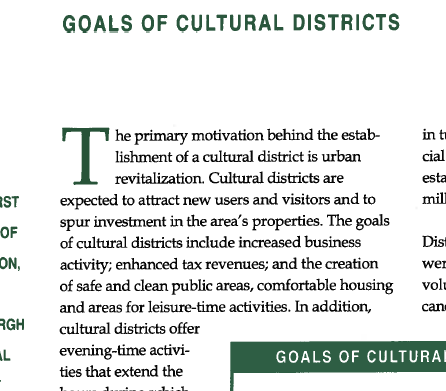

Now for some basic math: what happens to a neighborhood when
the tax base is “expanded,” property values “enhanced,” local businesses “complemented,”
and more “well educated employees” and tourists roll in? It should be clear to
all persons of good will and plain dealing that behind the bullshit euphemisms
we’re talking about jacking up rents, racist redlining by other means, and
cultural homogenization – in other words, gentrification.
The experience of Pittsburgh, summarized in the Americans
for the Arts report, gives us a more or less typical example of the forces and
motivations behind the founding of a cultural district:

The first paragraph blithely asserts that the district will
“link the interests and activities of historic preservation groups, arts
organizations and downtown developers” as if these interests somehow more or
less harmonized in the first place, with the further assumption that arts
organizations do indeed represent the needs of artists and urban communities
(in fact, arts organizations often represent the interests of urban elites
before those of artists and ordinary citizens). But in the next paragraph it clearly
emerges that the primary motivation for the district came from the big urban
developers themselves. Cultivation of the arts is spoken of in terms of revenue
generation, number of events and tickets sold (the Pittsburgh example is
primarily a theater district), with everything subordinated to the ultimate
goal of economic success in market terms. As long as someone’s basking in the
benjamins, it just stands to reason that “quality of life” is going up for the
whole “community”!
What’s instructive in these examples is how little it has to
do with art and culture. Cultural districts are not the spontaneous or organic
outgrowths of city dwellers and culture producers’ collective efforts to remake
their surroundings at the grassroots level; they are the deliberate creations
of real estate developers and investors, urban politicians (who get their
campaign bucks from the developers, not from poor artists!), and bureaucrats
from various nonprofits. Arts and culture are an instrumentality, a means to an
end, rather than an end in itself. This is what it means when you hear
supporters of the Literary Cultural District using words like “leveraging,”
“branding,” and “incentivizing” – it’s not just crappy word choice. In their
minds, a thriving culture is one that generates dollars, even though they will
invariably frame this as an “everyone wins” scenario.
If that’s your definition of culture, then these districts
should be fine with you. In fact they’re now so prevalent that they’ve even
begun establishing something like a trade association of their own, the Global
Cultural Districts Network. Click through their website and then get back to me
about what kind of "cultural" vibe they’re giving off.

Call me crazy, but to me it looks a little . . . corporate.
Of course someone might reasonably remark, gazing at the LCD
map and tracing a finger from Beacon Hill over to Newbury Street, that the area happens to be a tad . . . gentrified already, yes? To which the most accurate rejoinder
would be, Yes and No. It’s true that much of the area appears fully developed commercially and “vital” enough not to indicate an urgent remedy of
“revitalization.” But there remain hundreds of units of affordable/subsidized
housing both within the district itself and quite near its borders, as well as
enclaves – particularly Chinatown – where working class families still hang on.
The Literary Cultural District has a profit-oriented rationale for taking both types of urban terrain into its
capacious borders, and I’ll be addressing each in greater depth in Parts 2 and
3 of this post.
In the meantime, since you’ll be hearing more and more about
how great the district will be for writers, check out the findings of this
quantitative study of cultural districts!

May 13, 2014
Three Strikes Against the Literary Cultural District Public Hearing

A "community driven" effort.
The
Grub Street stage production of The Literary Cultural District Public
Hearing has come and gone after a single
performance at Boston Public Library’s Rabb Lecture Hall. The one-act farce,
co-produced by the Arts & Culture Committee of the Boston City Council, was
written by Eve Bridburg and directed by Michelle Wu. Playing the Stage Manager,
newcomer Larry Lindner turned in a harried, defensive performance – clearly
someone with professional credentials was needed in this part – while Christopher
Castellani and Henriette Lazaridis Power appeared listless and dispirited in
their supporting roles as The Writer and The Audio-Book. This left it up to Ayanna
Pressley, in her key role as The Politician, to pick up the slack, which she
did admirably. Pressley’s ambitious interpretation gave us one of those public
officials who really know the ABCs of their profession – Always Be Campaigning.
But even her nimble and rolling delivery couldn’t rescue a production that
seemed sabotaged from the start by its haplessly scattershot script, as if Ms
Bridburg had all along envisioned nothing more than a one-night engagement in
an almost empty hall . . .
A bit of theater:
It’s no exaggeration to say that the May 6 public hearing for the Literary Cultural District was never meant to be more than that. This is why the
project’s chief organizer, Grub Street, did nothing to publicize it. Or more
precisely, the publicity was as much a mere formality as the hearing itself was
supposed to be. Five hours before it was scheduled to start, Grub Street
condescended to mention it with a terse Facebook post and a tweet.
Grub Street
director Eve Bridburg defended her decision on Facebook, claiming, “Back in April, we
notified more than 50 media outlets and 74 other literary and civic
organizations. We hope to get a great turnout.” If this is true, then she was
grievously let down by these 124 organizations because not a single one of them made so much as a peep about the hearing either. Nor did any of the other organizations of the
LCD coalition, such as The Drum or
the Boston Book Festival. The only public notifications were the ones that were
mandatory – the official City Council posting and the BPL listing.
Grub Street
didn’t even avail itself of its own extensive email list. They could easily
have included an item about the hearing in the weekly newsletter, the Grub Street Rag, or they could have emailed a separate notification, as they
also do from time to time. Evidently their professed desire for a “great
turnout” was not especially ardent.
The Rabb Lecture
Hall at the Boston Public Library can accommodate 350 people, but for the LCD
hearing it was “filled” to only a tenth of its capacity, around 30-35 people.
And that’s being charitable, as this number includes those who had to be there,
such as the city workers operating the video and sound equipment, plus a couple
of party crashers – myself and my co-conspirator, Catherine – who only knew about
the hearing because they had gone looking for it (my testimony here). Most of
the rest of those present were invitees, lined up beforehand by Grub Street to
chime in according to the pre-approved script.
The
irregularities continued once the meeting got under way. Arts & Culture Committee chair Michelle Wu
might have wielded the gavel, but it was her colleague, Ayanna Pressley, who
was both the meeting’s official sponsor and its presiding spirit. Councilor
Pressley opened the proceedings by commending the “robust coalition” that was
“leading the charge” for the LCD, while also pointing out to the echoing
chamber and 320 empty seats that the effort was “community driven.”
The irregularity
here is that Councilor Pressley also happens to occupy a seat on Grub Street’s
“Literary Council.” Moreover, she’s a very recent addition to that group, appearing
for the first time in the Spring of 2013 – in other words when the discussions
for the LCD had to have been already under way in order to secure the $42,5000 “planning
grant” that they received from the Massachusetts Cultural Council (MCC) in Fall
2013.1 Out of the 38
individuals on the Literary Board, Councilor Pressley is the only one with no
professional connection to the literary world; the others are mostly writers,
with some agents and editors. I applaud Grub’s decision to have different
voices, perspectives, and backgrounds represented on the Literary Board,
including even “extra-literary” perspectives – but why then only this single one,
and with this particular timing?

I don’t have
access to the answers, of course, and therefore will only observe that it at
least gives the appearance of possible corruption and conflict of interest, of
a quid pro quo in which the city councilor is gifted an honorific and a line on
her CV in return for helping to lubricate the legislative process for certain
projects.2 Councilor
Pressley is routinely spoken of as a future star in our political firmament,
destined for higher office. A ceremonial seat on a literary board of merely
advisory capacity may not seem like much, but it is indeed something – culture nowadays
is a form of capital, and cultural capital confers prestige for a certain sector
of voters, and, much more crucially, of donors.
Now for strike
three, which wasn’t really brought home to me until the testimony of Dan Currie.
His perspective is significant because he served on the working team putting
together the application that will shortly be submitted by the LCD coalition to
the Massachusetts Cultural Council. Currie’s remarks were highly critical of
the coalition’s leadership – its “Executive Partners” as they have dubbed
themselves – and called for a process that was more transparent, open, and
inclusive than what he had seen so far.
Dan Currie
speaks with some authority here, because he was instrumental in shepherding an
earlier Boston literary site through the official process to become a city
landmark. It’s thanks to his efforts that we now have an Edgar Allan Poe
walking tour, a Poe Square at Boylston and Charles Streets, and soon a public
statue of Poe Returning to Boston that
actually looks dynamic, interesting, and flat-out cool instead of like the
usual bronzed dogshit. Yet a monument of presumably more conventional cut had
been the first choice of the project’s other leaders; it was only because Currie
had insisted on a more democratic process, soliciting greater public
participation and feedback than the officially required minimum, that a genuinely
popular result was achieved.
By contrast, the
LCD coalition’s “Executive Partners” are doing the opposite, barely fulfilling
even the letter of the law, let alone its spirit. This is especially the case
when it comes to their third strike: the scandalous decision to not release a
list of the district’s “assets” for public scrutiny and discussion before the application
is submitted to the Massachusetts Cultural Council. “Assets” is the MCC’s unlovely
and revealingly commercial term for the sites and properties that are supposed
to anchor a proposed cultural district – cultural attractions, of course, but
also business venues that might be associated, however tangentially, with the
cultural theme. In the Literary Cultural District’s case, such “assets” would
include specifically literary landmarks such as the Thoreau, Alcott, and
Hawthorne residences on Pinckney Street, but also businesses such as hotels,
bars, and restaurants with any vaguely literary connection (Malcolm Lowry
barfed here!), and of course organizations like Grub Street itself.
Instead, all
that was revealed at the public hearing was an empty map. The borders
delineated a quite large swath of Boston real estate, from downtown in the east
to Copley Square and beyond in the west, and from Beacon Hill in the north to
Washington Street in the south – with an elbow poking into the rapidly
gentrifying Chinatown. There were no markers for any literary sites on the map,
no key, and no list. The whole rationale for creating this district in the
first place was missing, excluded from consideration.

Of all the
irregularities, this was definitely the weirdest. The excuse for it, related by
the visibly nervous Larry Lindner, was that there wasn’t time to get “bogged down” in “details” or tied up in
endless debates about which sites should or shouldn’t be included in the
district (yes, Larry, democracy can be messy and inconvenient). Moreover, Lindner
further stammered, the list could change any time, sites could be added at any
point, and even the boundaries of the map itself could change, so it didn’t
really matter right now, did it?
In her closing
remarks Councilor Pressley came to Lindner’s aid by affirming that this was
going to be a “nimble and rolling process” and then repeating it several times
to make sure we all got it: “a nimble and rolling process, a nimble and rolling
process . . .” Although intended to reassure, it raises the question of just who is getting rolled here.
Councilor
Pressley also thanked Councilor Wu for “expediting” the scheduling of the
hearing itself. Along with Lindner’s anxiety about getting “bogged down,” this
contributed to the impression that the process is being rushed for some undisclosed
reason. Originally (in 2013) the Grub-led coalition had been awarded a two-year
planning grant, with talk that the district itself might be unveiled “sometime
in 2015.” Now we’re being told that the christening might take place before the
end of this year.
Why the rush?
What is being kept from the public? And what is being committed in the name of
writers, who have a responsibility to be good stewards of the language, and
speak the truth?
Three strikes against the LCD public
hearing:
Strike 1:
Not publicized
Strike 2:
Not impartial
Strike 3:
Not informed
You’re
out!
_____________________________________________
1 The Massachusetts Cultural Council (MCC) is the state agency
that, among other things, administers cultural districts within the
Commonwealth.
2 This is additionally ironic when we remember Ayanna
Pressley’s vote to expel Chuck Turner from the city council in 2010. Turner, member
of the Green-Rainbow Party and a longtime Boston activist, was about as close
as we might have come to a genuine ‘people’s’ representative in city government
in our time – that is, until he was framed by the FBI for allegedly accepting
gifts in return for political favors.
Subscribe to:
Posts (Atom)


 Posts
Posts


