November 8, 2014

Tidy Words & the End of the World: LeRoi Jones Reads a New Yorker Poem


Here’s a scene from Amiri Baraka’s Autobiography of LeRoi Jones. He’s dropped out of Howard University and joined the Air Force (the “Error Farce,” he calls it) and they’ve stationed him in Puerto Rico. For the US it’s the mid-1950s and for Jones it’s early days in his writing vocation; he’s just feeling his way and trying to assimilate everything that seems to fall under the rubric of literary culture, which so far appears to be white, Anglo-European culture.

One afternoon I had gone to San Juan by myself. I had found some places in Old San Juan I could walk around. They had a tourist section, fairly arty . . . I was in civilian clothes and I remember I was reading The New Yorker. I’d stopped at a bench and sat down near a square. It was quiet and I could see a long way off toward the newer, more Americanized part of the city, the Condado Beach section, where I could only go if in uniform, so they would know I was an Americano and not a native. I had been reading one of the carefully put together exercises The New Yorker publishes constantly as high poetic art, and gradually I could feel my eyes fill up with tears, and my cheeks were wet and I was crying, quietly, softly but like it was the end of the world. I had been moved by the writer’s words, but in another, very personal way. A way that should have taught me even more than it did. Perhaps it would have saved me many more painful scenes and conflicts. But I was crying because I realized that I could never write like that writer. Not that I had any real desire to, but I knew even if I had had the desire I could not do it. I realized that there was something in me so out, so unconnected with what this writer was and what that magazine was that what was in me that wanted to come out as poetry would never come out like that and be my poetry.

The verse spoke of lawns and trees and dew and birds and some subtlety of feeling amidst the jingling rhymes that spoke of a world almost completely alien to me. Except in magazines or walking across some campus or in some house and neighborhood I hadn’t been in. What was so terrifying to me was that when I looked through the magazine, I liked the clothes, the objects, the general ambience of the place – of the life being lived by the supposed readers and creators of the New Yorker world. But that verse threw me off, it had no feeling I could really use. I might carry the magazine as a tool of my own desired upward social mobility, such as I understood it. I might like some of the jokes, and absolutely dig the soft-curving button-down collars and well-tailored suits I saw. The restaurants and theater advertisements. The rich elegance and savoir faire of all I could see and touch. But the poem, the inside, of that life chilled me, repelled me, was impenetrable. And I hated myself because of it, yet at the same time knew somehow that it was correct that I be myself, whatever that meant. And myself could not deal with the real meanings of the life spelled out by those tidy words.

Baraka nails the essential quality of the New Yorker poem in a compact formulation: a carefully put-together exercise published as high poetic art. And when it comes to literary standards nothing has changed in the half century plus since the poet shed tears over that alienating poem – New Yorker still puts a premium on carefully put-together exercises that it publishes as high poetic art. This is just as true of the magazine’s fiction, which represents the “quality” apogee of the MFA cookie-cutter “epiphany story.” Wrapped up in tidy packages of psychological realism, these stories reflect the spurious “humanism” of the liberal professional-managerial class that is really a form of fatuous, self-congratulatory narcissism and an apologetics for a racist, imperialist, and exploitative status quo. Such work is “well-crafted,” meticulous, careful, “clean,” and absolutely risk free – the literary equivalent of a gentrified neighborhood. It’s a neighborhood (Baraka even calls it, perceptively, a “place”) where people like the aspiring Black writer are not welcome, where they are the excluded Other.

In the yearning for social mobility that painfully inflects his response, the young poet of the autobiography implicitly realizes how this “high poetic art” functions as a marker of status, what Pierre Bourdieu calls “distinction.” New Yorker verse and fiction are indeed high-end consumer commodities, of a piece with the tailored clothes, pricey jewelry, and haute cuisine dining spots that share its pages. It’s a cultural “address”, but – as commentators such as Sharon Zukin and David Harvey have shown – one that is eminently available to be cross-mapped onto real space, in urban neighborhoods across the US and around the globe.

One way that this type of “cultural address” manifests itself in the contemporary urban arena is the phenomenon of “cultural districts,” specially designated clusters of arts and humanities venues which then become the focus of public-private investment partnerships. There are many such districts in Massachusetts already, including two here in Boston, the Fenway Cultural District and the new Boston Literary District. According to the Massachusetts Cultural Council, the state body that awards such designations, the ultimate goal of cultural districts is “enhancing property values and making communities more attractive” – i.e., gentrification.

In their critique of the “creative cities” model of urban development, researchers Sacha Kagan and Julia Hahn speak of the results of such cultural zoning – an exclusionary “club effect”:

In the creative city model, culture is used to increase value, be it symbolically through images or materialized. In this context, Zukin (1990) refers to “real cultural capital,” meaning spatially linked cultural capital, which becomes a reason for real investments (p. 38). As Bernt & Holm (2005) state, the cultural capital (of artists) becomes objectified and transfers onto certain places; this, in turn, makes access to it easier, as it can be consumed by anyone who enters this space. Ley (2003) examines gentrification processes and how the high level of cultural capital of artists increases the symbolic value of an area and leads to “followers” (other professionals with high levels of cultural, but also economic, capital) coming into a neighbourhood. He uses Bourdieu‟s notions of cultural and economic capital and finds that both of these concepts help to explain gentrification. [ . . . ]

Bourdieu (1999) also describes the “club effect” as a process that excludes according to economic, cultural, and also social capital. Select spaces acquire social and symbolic capital based upon “people and things which are different from the vast majority and have in common … the fact that they exclude everyone who does not present all the desired attributes …” (p. 129). This “club effect” shows that consequences like segregation and symbolic violence can result from a policy that “favors the construction of homogeneous groups on a spatial basis” (p. 129) This can be connected to the creative city concept, in which arts and culture function as enablers for a creative urban milieu, in turn enhancing the city economically and often resulting in gentrification. Artists or “creatives” play an important role here and can be seen as pioneers of gentrification, as they give their cultural capital to a certain district or space. As Bernt & Holm (2005) describe, gentrified spaces become more and more general, losing the specific characteristics that enabled their cultural distinctiveness.

The organizers of the Boston Literary District – led by Eve Bridburg and the Grub Street writing center – like to pretend, at least in public statements, that their cultural zone is innocent and inclusive. In fact in their application to the Massachusetts Cultural Council they went so far as to produce the following howler:

"Also, unique to this district, situated in a gentrified area, is that it will allow literary groups and writers in more economically marginalized areas of Boston to strut their literary stuff, if you will, by participating in district programming."

Accomplished here is the feat of making a single sentence out of a stew of euphemism, wishful thinking, and flat-out lie. The truth is that the borders of this very large chunk of Boston real estate encompass or abut areas such as Chinatown and Downtown Crossing that are alive with ongoing struggles against gentrification. Public and affordable housing units as well as soup kitchens and homeless and domestic abuse shelters are all in the crosshairs now. In the “mixed-use” (both commercial and residential) areas south and east of Boston Common, household incomes are among the most savagely polarized in the region, with luxury condos grudgingly rubbing shoulders with tenements and SRO hotels. In their statements and actions the Boston Literary District’s sponsors have disappeared those places, and those people.

But it’s also true that parts of the district, such as Beacon Hill and the Back Bay, are already quite gentrified. Will the minority youth of Boston – because that’s who we’re talking about here – really be welcome to “strut their stuff” on that stage?

To answer this question let’s put a couple of things together. The first is a quote from the Globe article that heralded the Literary District’s advent back in the fall of 2013.

It’s been 18 months since the Massachusetts Cultural Council began designating cultural districts around the state. So far, 17 areas have been named, giving them the right to create signage, and also a boost in attracting artists, creative enterprises — and cultural tourists, who spend $62 more per day than their philistine counterparts.

Cultural tourists spend $62 more per day than their philistine counterparts. We’ll let slide for the moment the irony that nothing marks the true philistine more than putting a dollar value on culture and instead focus on something else: What kind of demographic are we really talking about here? Well, what else could it be but well-heeled and mostly white upper-middle class professionals out on the hunt for further marks of cultural “distinction”? In other words – New Yorker readers.  

Now let’s add to that another little fact of Boston life that’s come to light recently. Or rather, come to light for those who don’t experience it daily: the racist “stop and frisk” policing of Black and Latino youth that is endemic to this city, as reported by the ACLU after an exhaustive study. 

You don’t have to be a math whiz to see that these two items add up to Black and brown youth not being particularly welcome to “strut their stuff” anywhere, let alone in the Boston Literary District. In fact, as a comprehensive report by Dan Shewan in DigBoston revealed last September, the real purpose of the district is further gentrification of the region. This is where the “club effect” cited above by Kagan and Hahn comes into play: it “favors the construction of homogeneous groups on a spatial basis,” (in this case the affluent “cultural tourists” flocking to the Literary District), and it results in “segregation and symbolic violence” for those left out of the club.

Social exclusion and symbolic violence inflict real damage and pain, the pain of marginality, invisibility, and muteness – cultural apartheid. It is precisely the type of pain that Amiri Baraka’s younger self experienced while reading that New Yorker poem. The passage from Baraka’s autobiography struck me because I encountered it at the very time I was writing about the Boston Book Festival’s failure, for the fifth year in a row, to select a local African American or Latina/o author for their flagship “One City One Story” program. One of the “Executive Partners” in organizing the Boston Literary District, the BBF states that this citywide “Big Read” event is supposed to promote literacy and “create a community around a shared reading experience.” Yet what kind of community are they creating? Boston is at least 42% Black and Latina/o, but in the 5 years of One City One Story’s existence they’ve chosen 4 white authors and 1 Asian-American author. The stories themselves, moreover, are very much of the same “carefully constructed exercises” (white and uptight) that continue to be published “as high poetic art” in the New Yorker.

I wonder how many minority youth in Dorchester, Roxbury, and Mattapan were assigned the book festival’s 2014 offering, Jennifer Haigh’s “Sublimation,” in their high school English classes. No doubt they were exhorted that they were participating in civic life, and that the story’s values and outlook were somehow “universal” and relevant to their own experience. And no doubt that many of them felt the same confusion and shame and anger that LeRoi Jones felt reading that New Yorker poem in San Juan over a half century ago.

I hope none of them shed tears over it, though – the story wasn’t worth it.

Rest in power, comrade Amiri Baraka!


October 22, 2014

THE FACE OF GENTRIFICATION: "One City One Story" at 5 Years

Below is the text of a leaflet for Boston Book Festival 2014:

For the fifth year in a row the Boston Book Festival has failed to select a story by an African American or Latina/o author for their flagship One City One Story (1C1S) program. One of those citywide “Big Reads” currently in fashion around the nation, the program prints 30,000 booklet copies of a short story by a local author and distributes them for free in libraries, bookstores, and coffee shops around the region. The story serves as the platform for a number of reading and discussion activities, all leading up to a big Q&A with the author at the festival itself. The program, according to its organizers, is intended to promote literacy and “create a community around a shared reading experience.”

With the selection of Jennifer’s Haigh’s “Sublimation” 1C1S enters its fifth year, and we can now get a clear picture of just what sort of “community” the program has in mind:


The book festival’s idea of “community” is blatantly unrepresentative of the real Boston, which by the 2010 Census had at last become a “majority minority” city, in which people of color make up around 53%:

Black or African American            24%
Latino/a or Hispanic                      18%
Asian                                                   9%
Other                                                  2%
So-called “White”                           47%
           100%

Now here’s the breakdown for 1C1S:  2 white men (Tom Perrotta in 2010 and Richard Russo in 2011), 2 white women (Anna Solomon in 2012 and this year’s Jennifer Haigh), and 1 South Asian woman (Rishi Reddi in 2013). That’s 80% white and 20% Asian = 100%!

Boston is at least 42% Black or Latino, but 100% locked out of One City One Story. It’s the “literary” equivalent of a gated community.

It’s not like there’s a shortage of Black or Latina/o writers who have significant ties to the region. If it’s marquee names you’re looking for, there’s Junot Diaz, Jamaica Kincaid, Julia Alvarez, and John Edgar Wideman. Both Michael Thomas and Danzy Senna were born and raised in Boston even if they now live elsewhere. Closer to home we have Laura K Warrell, Jennifer De Leon, Marcus Burke, Iris Gomez, and others. Chapters from Burke’s novel, Team Seven, or Gomez’s Try to Remember would’ve made first-rate One City One Story choices.

Of course it’s not up to us to do the BBF’s homework for them. If you claim to speak for “the community,” you should know what you’re talking about. But of the 45 people listed on their website’s Who We Are page, only 2 are African American and none Hispanic – again a laughable (and lamentably tokenistic) proportion considering Boston’s real demographics. Instead, their Board of Directors is a miniature Who’s Who of the region’s white plutocracy, with a hedge fund banker, a marketing research CEO, a senior investment officer; people with decades of experience in places like Salomon Brothers and Goldman Sachs who push causes like corporate “education reform.”

But even if the BBF organizers are ignorant about the community, that’s not the biggest scandal here – it’s that they don’t give a fuck. They are in fact quite consciously and deliberately constructing the community they want, as part of a process unfortunately familiar to us all: gentrification.

Local literary institutions such as Grub Street, the Boston Book Festival, and others are currently congratulating themselves on the founding of the so-called Boston Literary District, stretching from downtown to the Back Bay. A recent report in DigBoston by Dan Shewan exposed the top-down and closed-door manner in which the project was undertaken, suggesting that it has more to do with commerce than culture and will help property developers and the hospitality industry a lot more than writers, readers, and the community at large. Indeed, even the state body governing the creation of such districts admits that their purpose is to “enhance property values”, i.e., gentrification.

As Boston’s working class people of all races struggle with spiraling rents, Black and Latino/Hispanic youth face additional pressures such as the racist stop-and-frisk policies of the Boston Police Department, revealed earlier this month by the ACLU. The Boston Book Festival and their One City One Story program enact a cultural violence on the same continuum, policing urban space on behalf of the white ruling class and its professional-managerial servants and supporters (the festival’s target audience). But a genuinely thriving culture will never arise from ethnic cleansing and apartheid. Another Boston is possible, and a very different – and more diverse – book festival along with it. 


August 29, 2014

Grub Street Saved from Gentrification!


As we reported in our previous post, a cash-strapped Grub Street writing center has told the world that it is barely holding on in the midst of a furious storm of gentrifying downtown development. But before it would be forced to relocate to some strip mall outside Route 128, come hell or high water it was going to establish the Literary Cultural District, which will safeguard both Boston's literary heritage as the "Athens of America" (because one good slaveholding democracy deserves another) and the city's current and much-remarked "literary renaissance." 

Well, now we don't have to worry any more – a source of funds has been found which will allow Grub Street to remain downtown in the Steinway Building, or at least somewhere else within our new Literary Cultural District: Eve Bridburg's salary.

(I've blurred out information on individuals who don't concern us here)

Yes, publicly-available tax documents obtained by this blog reveal that Grub Street's Founder and Executive Director earned a remarkable $104,020 in 2012. That's 3 times the median per capita income of the city, $33,000 a year.

Also impressive is the steep rise her salary has undergone in the last few years, from 60 grand in 2010 to 95 grand in 2011 – a raise of 35 thousand dollars in a single year, followed next year by another bump of 10 grand! And at that rate, who knows what her raise for 2013 might've been? 

All Ms. Bridburg has to do is return to her 2010 salary – still almost twice as much as the median Boston per capita income – and Grub will be flush enough to remain the stout tentpole of the Literary Cultural District.

And don't worry too much about our Executive Director: Her spouse is an extremely well-remunerated doctor with his own lab in the Longwood Medical District, so this great gift she is giving won’t pinch her family too much. This is an era in which we're all being forced to tighten our belts, and pull ourselves up by our own bootraps or be hoisted upon our petards or whatever, so it only stands to reason that the Great Mother of our Literary Renaissance will do her part, too.

August 26, 2014

Eve Bridburg Finds the Gentrification-Spot!


G marks the spot!

On August 19, the Massachusetts Cultural Council approved the “Literary Cultural District” application submitted by GrubStreet writing center and a raft of other Boston literary organizations. The approval was punctuated by the usual round of media flatulence, including this offering by BostInno dudebro Nick DeLuca: “It marks the second state-designated area of this kind – the first, also in Boston, being the Fenway Cultural District – and the inaugural in the nation being of the literary variety.” This marks the fifth article on the LCD by DeLuca being of the illiterate variety.

But in the midst of all the triumphalism an uncharacteristic note of caution sounded from the van of the parade. Consider the following quote in the same article from none other than GrubStreet founder and director Eve Bridburg:

Areas like Fort Point channel have seen their artistic communities pushed out due to rising costs, and GrubStreet faces a similar challenge as our building is being sold and we too are being forced to consider options outside of the city. The approval of the creation of a literary cultural district in downtown Boston is an important milestone for a city that is trying hard to maintain its cultural heart. With an intentional, coherent approach to our collective work as literary organizations, publications and endeavors, we will put Boston on the map as a literary center and destination.

I had to rub my eyes and even walk around the block when I read this: Eve Bridburg talking about . . . gentrification? Who said anything about gentrification? How did this notion even enter the conversation? When in the year-long public history of this project have its organizers, spokespersons, and media shills expressed the least syllable of concern about the g-word?

That Gioconda smile can only mean one thing!

While we’re pondering that question (or alternately savoring the cheeky humor behind the assertion that the city is “trying hard to maintain its cultural heart”), let’s spice it up with two additional ironies:

1) Bridburg and Co. have waited until the district is a done deal to say anything about gentrification. I’ve been watching this process unfold for a year now, thinking hard about it and doing the homework about cultural districts and gentrification that the LCD's supporters don’t seem to be interested in. And during that time, there’ve been some things that have struck me – as they would any honest observer – as deeply manipulative and dishonest, including the obvious conflicts of interest (Ayanna Pressley’s seat on GrubStreet’s “Literary Council” and Grub board member and donor Laura Debonis’s boasted residence “in the literary cultural district”), the deliberate deception about the openness of the project (no substantive attempt to rally people to the “public” hearings), and the egregious corruptions of language from people professing to be writers or book lovers (“literary renaissance,” “branding,” and the serial abuse of “community”, etc.). But so far nothing beats this for sheer cynicism.

Because Eve Bridburg herself has just admitted that concerns about gentrification are relevant to this process. In fact they are so relevant that the very first public words out of her mouth after the district’s final approval address this very topic. Yet concerns about gentrification could’ve been addressed at any time along the way. Waiting until this moment gives the impression that the organizers failed to bring it up because they knew that due diligence and genuine democratic participation and accountability might cause problems or slow the process. Instead, they kept their mouths shut and rushed the process as much as possible.

By waiting until now, Eve Bridburg couldn’t have admitted more loudly that gentrification is a legitimate concern when it comes to the literary cultural district – and she couldn’t have added any louder that she doesn’t give a shit.

2) Bridburg’s statement suggests that LCD status will somehow actually help with the problems posed by gentrification. This is of a piece with other vague assurances such as the repeated assertions that the LCD will “help writers” by “raising their profiles” or whatever other “branding” bullshit is on offer. But in real terms it’s a non sequitur (as well as a plain old lie), because cultural districts, as I’ve shown in previous posts, were developed for the very purpose of bringing up property values. The same sleazy rhetorical move is on display at the end of an unsigned Boston Globe editorial that appeared several days after Bridburg's statement:


Here, too, gentrification is acknowledged as a problem, but here as well the district is rhetorically positioned as some kind of vague potential solution rather than what it in hard fact is: an aggravating factor. The idea that GrubStreet itself might be gentrified out the area by the sale of the Steinway building is nothing but a bit of “poor me” misdirection – loyal Grubbies have nothing to worry about when it comes to the tentpole status of their favorite cultural arbiter. A glimpse at the overlapping personnel among GrubStreet’s board of directors and their donors make it clear that the writing center has been steadily pimping its Muse to bigger and bigger players in the Marketplace and will do just fine in the “creative economy” of Boston’s future.

At least the Massachusetts Cultural Council, a state agency, feels constrained in its own announcement to be more forthright about the purpose of cultural districts:


Take note of a couple of points in particular. The MCC reports that, "the Cultural Districts Initiative grew out of an economic stimulus bill" – an ECONOMIC STIMULUS BILL, not some kind of fairy-tale, feel-good "cultural stimulus bill"! The language of the third paragraph drives the point home: to "encourage business," "expand tourism," and "enhance property values." Could it be any clearer?  

Now, someone might logically point out that there are one or two points about art and culture in the description, such as "attract[ing] artists and cultural enterprises" and "foster[ing] local cultural development" – shouldn't that count for something? And of course it does: it counts for the kind of art that can "encourage business"; it counts for the kind of culture that will "expand tourism"; it counts for the type of creativity that will "enhance property values." This is a recipe for gentrification.

So to sum up, here’s what Eve Bridburg and GrubStreet and the other “Executive Partners” in the LCD coalition (Deborah Porter of the Boston Book Festival, Henriette Lazaridis Power of The Drum litmag, plus Suffolk University, Emerson College, the Boston Athenaeum, and Boston Public Library) are telling you:

Gentrification is a real issue here, but the Literary Cultural District will somehow help with that in some unspecified way, even though cultural districts were designed to do just the opposite, and anyway it’s too late because we waited until the LCD was in the bag to mention any of this inconvenient crap.

OK, got it – thanks, GrubStreet!


July 30, 2014

The "Literary Cultural District" and the Art of Rent -- Part 1


When the fix is in, the fix is in: On Wednesday, June 25, the Boston City Council voted unanimously in favor of the Literary Cultural District proposal submitted by a coalition of local organizations led by the Grub Street writing center and its director, Eve Bridburg. This came after a second hearing for the district that was almost as poorly publicized as the first. Now the application has been kicked up to the Massachusetts Cultural Council to determine if it meets the state’s guidelines. In the meantime Grub Street has been on a mini publicity blitz, with Bridburg’s hype man, Larry Lindner, crowing that the district could be a reality as early as September of this year.

Does that mean Grub Street will be returning half of the 2-year planning grant it received from the state in the Fall of 2013? (42,500 taxpayer bucks for a project repeatedly billed as “revenue neutral.”) Somehow I think not, but at this point such straightforward theft is one of the less sleazy aspects of this case. As a writer – and a just as a rational, ethical human being – I’m more offended by their serial abuse of an infinitely more precious currency: language. For example, in the latest wave of uncritical, rah-rah articles about the project, city councilor Ayanna Pressley is quoted applauding the district because it will “incentivize foot traffic” in the area. Any writer worth her salt will be deeply revolted by this kind of thing, as she would’ve by Eve Bridburg’s classic from an earlier interview, “We’re thinking about branding the work that everybody is doing.” Worst of all is that “Literary Cultural District Coordinator” Larry Lindner is back to claiming that Boston is in the midst of “a literary renaissance.” During the city council process a chastened, or at least more cautious, Grub Street had downgraded their momentous cultural rebirth to a still hugely overstated “resurgence.” It’s a sure sign they feel the wind in their sails that they’ve now returned to the brazen ad-speak – or what, in simpler times, was known as lying – of “renaissance.”

The single note of caution sounded in the recent spate of press reports was over the district’s walkability – a requirement of the MCC guidelines. And if we look at the crude map that Grub Street released, it is indeed a sizeable chunk of downtown real estate.


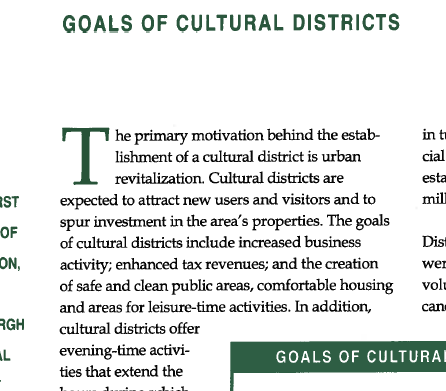
But that’s what it’s really been about all along, isn’t it – real estate? The urban policy of cultural districts was first created for the very purpose of “revitalizing” – code word for gentrifying – economically depressed neighborhoods in cities ravaged by de-industrialization and other vagaries of a market economy. Take a look at this 1998 “Americans for the Arts” report, Cultural Districts: The Arts as a Strategy for Revitalizing Our Cities, sponsored by a group of urban mayors, business associations, and arts administrators. By that time, the report states, there were already 90 cities in the US that had founded or planned such districts. Examine the language used to describe the function of cultural districts in these two excerpts:


Now for some basic math: what happens to a neighborhood when the tax base is “expanded,” property values “enhanced,” local businesses “complemented,” and more “well educated employees” and tourists roll in? It should be clear to all persons of good will and plain dealing that behind the bullshit euphemisms we’re talking about jacking up rents, racist redlining by other means, and cultural homogenization – in other words, gentrification.

The experience of Pittsburgh, summarized in the Americans for the Arts report, gives us a more or less typical example of the forces and motivations behind the founding of a cultural district:
                                                           

The first paragraph blithely asserts that the district will “link the interests and activities of historic preservation groups, arts organizations and downtown developers” as if these interests somehow more or less harmonized in the first place, with the further assumption that arts organizations do indeed represent the needs of artists and urban communities (in fact, arts organizations often represent the interests of urban elites before those of artists and ordinary citizens). But in the next paragraph it clearly emerges that the primary motivation for the district came from the big urban developers themselves. Cultivation of the arts is spoken of in terms of revenue generation, number of events and tickets sold (the Pittsburgh example is primarily a theater district), with everything subordinated to the ultimate goal of economic success in market terms. As long as someone’s basking in the benjamins, it just stands to reason that “quality of life” is going up for the whole “community”!

What’s instructive in these examples is how little it has to do with art and culture. Cultural districts are not the spontaneous or organic outgrowths of city dwellers and culture producers’ collective efforts to remake their surroundings at the grassroots level; they are the deliberate creations of real estate developers and investors, urban politicians (who get their campaign bucks from the developers, not from poor artists!), and bureaucrats from various nonprofits. Arts and culture are an instrumentality, a means to an end, rather than an end in itself. This is what it means when you hear supporters of the Literary Cultural District using words like “leveraging,” “branding,” and “incentivizing” – it’s not just crappy word choice. In their minds, a thriving culture is one that generates dollars, even though they will invariably frame this as an “everyone wins” scenario.

If that’s your definition of culture, then these districts should be fine with you. In fact they’re now so prevalent that they’ve even begun establishing something like a trade association of their own, the Global Cultural Districts Network. Click through their website and then get back to me about what kind of "cultural" vibe they’re giving off.


Call me crazy, but to me it looks a little . . . corporate.

Of course someone might reasonably remark, gazing at the LCD map and tracing a finger from Beacon Hill over to Newbury Street, that the area happens to be a tad . . . gentrified already, yes? To which the most accurate rejoinder would be, Yes and No. It’s true that much of the area appears fully developed commercially and “vital” enough not to indicate an urgent remedy of “revitalization.” But there remain hundreds of units of affordable/subsidized housing both within the district itself and quite near its borders, as well as enclaves – particularly Chinatown – where working class families still hang on. The Literary Cultural District has a profit-oriented rationale for taking both types of urban terrain into its capacious borders, and I’ll be addressing each in greater depth in Parts 2 and 3 of this post.

In the meantime, since you’ll be hearing more and more about how great the district will be for writers, check out the findings of this quantitative study of cultural districts!